
Anchor Piles
Ground Anchoring & Excavation Support Specialists
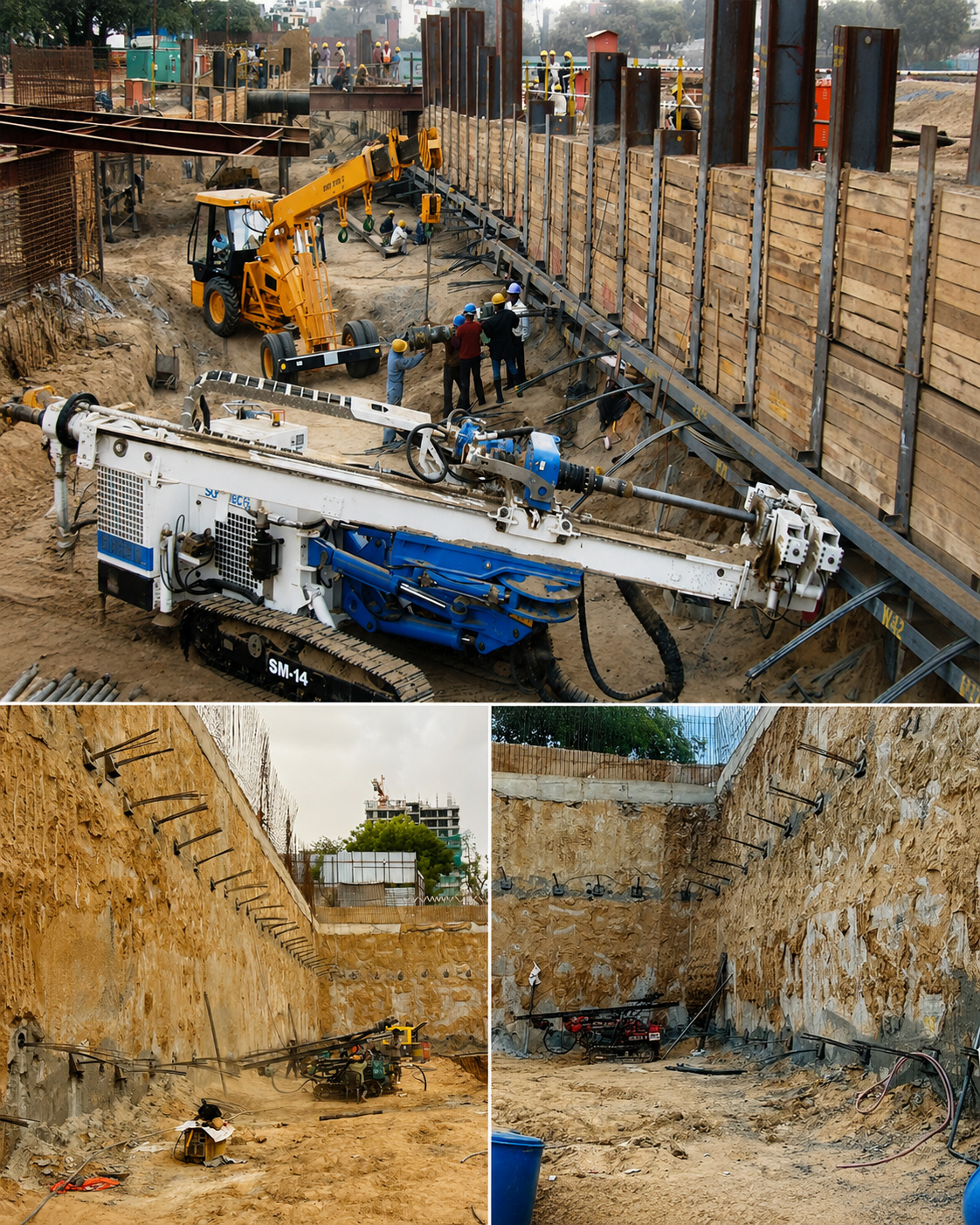
Jalmala Boring Works provides permanent and temporary ground anchor systems for diaphragm wall support, retaining walls, deep excavations, basements, and slope stabilization. Our high-capacity anchor piles are drilled, grouted, tested, and stressed to transfer lateral loads into stable ground, ensuring maximum structural stability, minimal wall movement, and safe excavation for commercial, industrial, infrastructure, and metro projects.
Ground Anchor(Tieback) Construction Process
A detailed step-by-step guide of how Jalmala Boring Works installs high-capacity Ground Anchors / Tieback Anchors for deep excavation support.
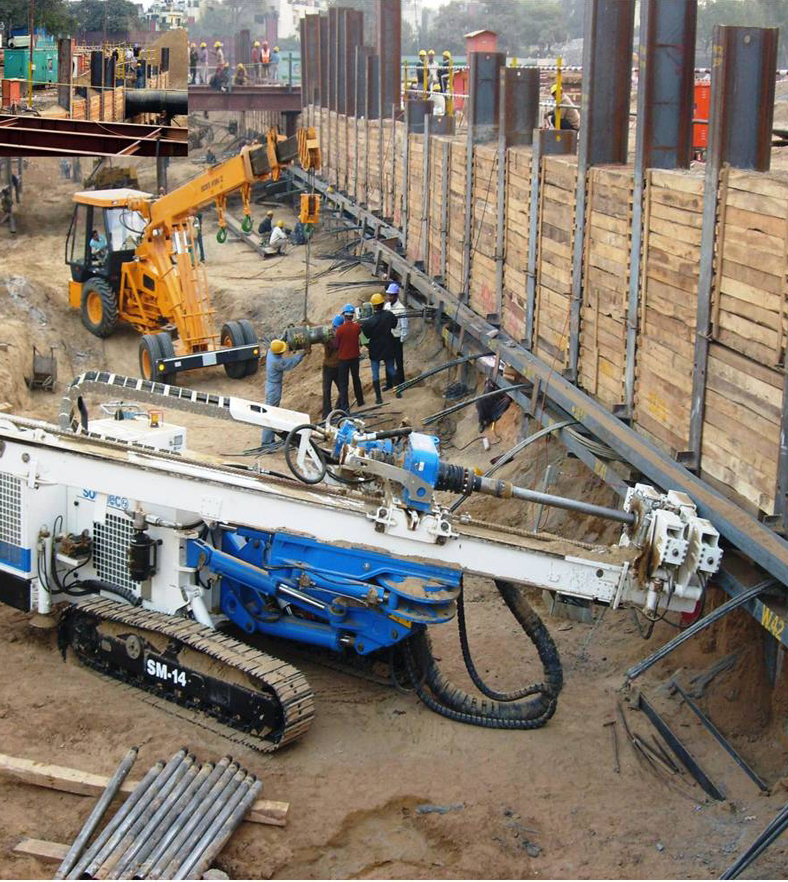
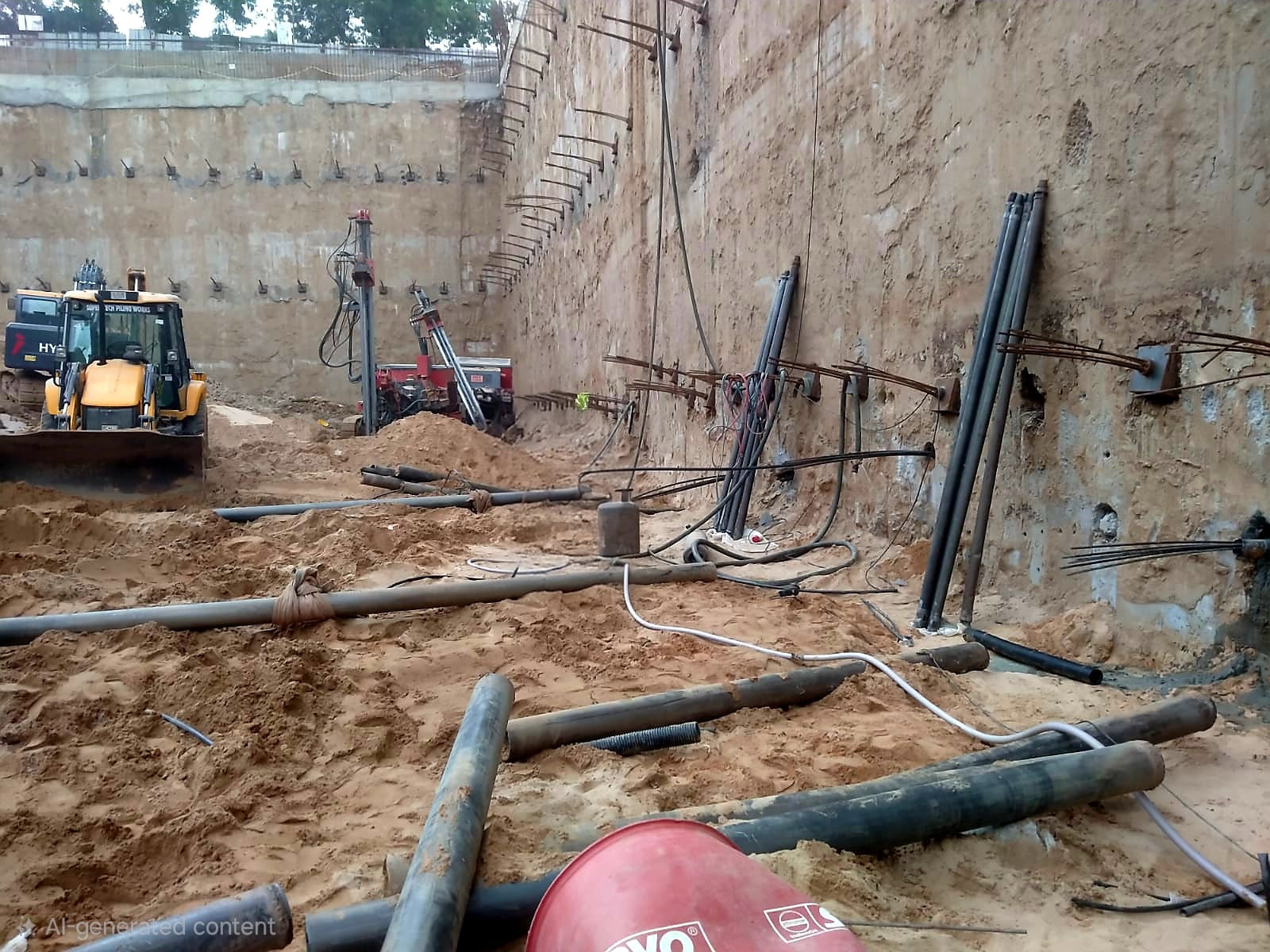
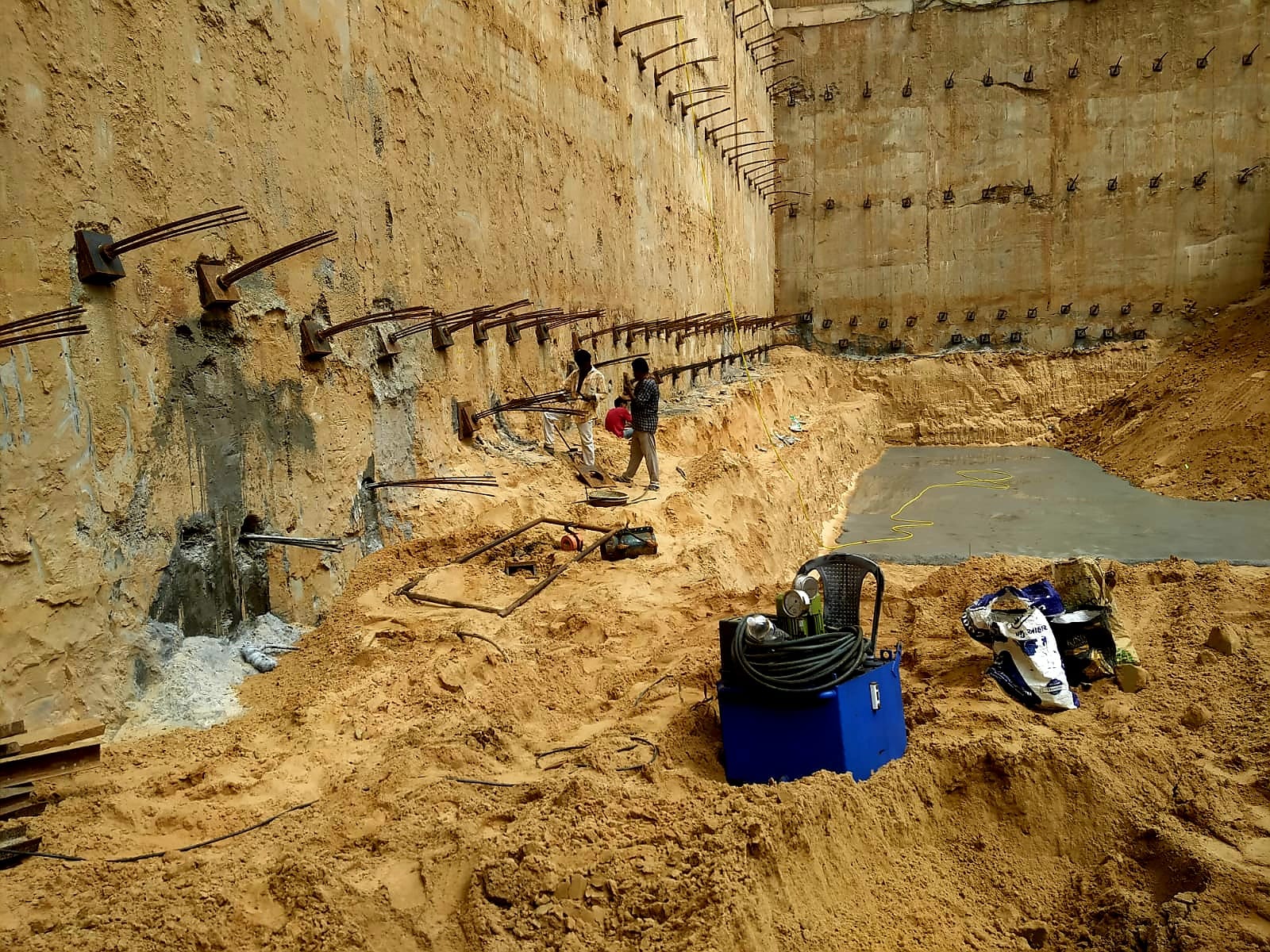
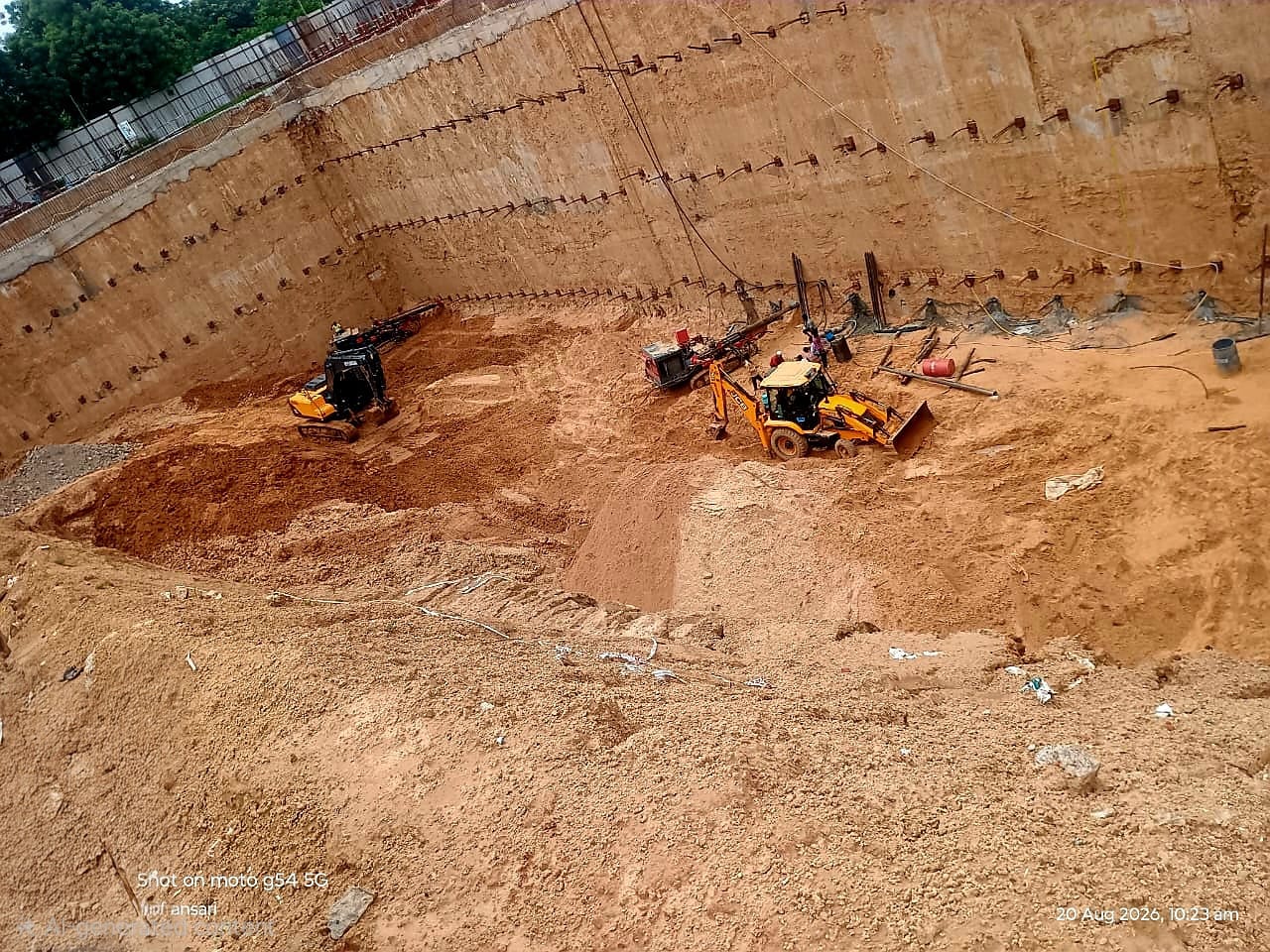
Survey, Setting Out & Anchor Positioning
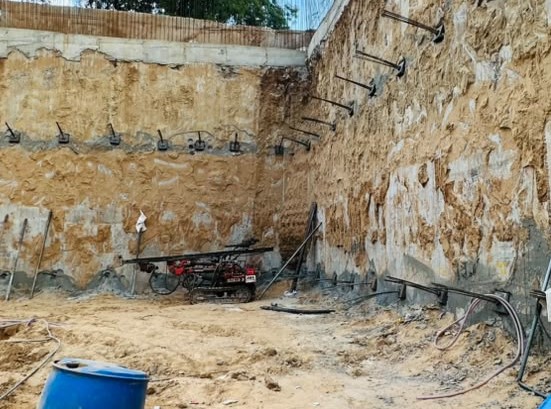
Survey, marking, and positioning of anchors with precise inclination and coordinates.
- Survey and mark anchor locations as per approved drawings
- Determine anchor inclination, spacing, depth, and capacity
- Set up Hydraulic Anchor Drilling Rig
- Verify wall levels and drilling coordinates
- Ensure safe working platform and access
Anchor Hole Drilling
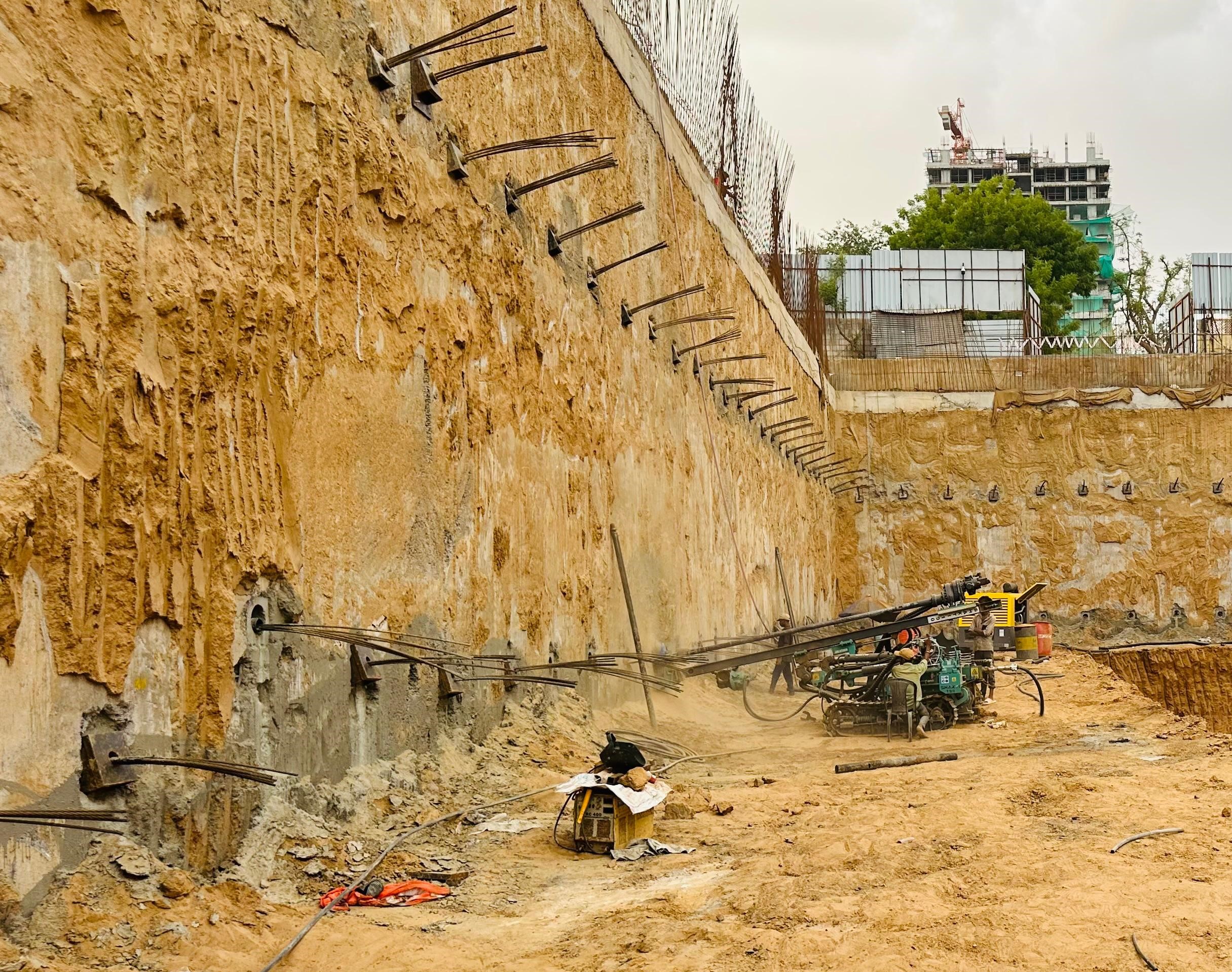
Drilling of inclined boreholes using hydraulic anchor rig.
- Drill inclined boreholes through diaphragm wall or retaining structure
- Use Hydraulic Anchor Rig with rotary/percussion system
- Drill to required length and stable strata
- Monitor drilling angle, depth, and diameter
- Clean boreholes using compressed air or water flushing
Anchor Tendon Installation
Insertion of prestressed strands or bars with corrosion protection.
- Insert prestressed steel strands or threaded anchor bars
- Install centralizers, sheathing, and corrosion protection
- Ensure proper free length and bonded length
- Accurate positioning within the borehole
- Pre-grouting inspection and approval
Grouting Operations
High-pressure grouting to bond the anchor tendon with surrounding ground.
- Inject cement grout or chemical from bottom to top
- Create strong bond between tendon and soil/rock
- Fill all voids and ensure complete encapsulation
- Maintain specified grout pressure and quality
- Allow grout to achieve required strength
Anchor Stressing & Lock-Off
Stressing of anchors to design load and lock-off.
- Install anchor heads, bearing plates, and wedges
- Test anchors using hydraulic jacks
- Stress anchors to the required design load
- Lock-off at approved working load
- Record elongation and test results
Quality Control & Excavation Support
Testing, monitoring, and long-term performance verification.
- Verify performance through proof and lift-off tests
- Monitor wall movement and anchor loads
- Install additional levels as excavation progresses
- Complete testing records and documentation
- Provide continuous lateral support to deep excavations
Recent Projects
Anchor Piles vs Soil Nails – Complete Comparison for Indian Projects
The comparison of anchor piles vs soil nails comes up constantly in geotechnical discussions — and it is often misunderstood. These are not competing solutions for the same problem. Anchor piles and soil nails serve fundamentally different purposes, and choosing the wrong one can lead to over-design, under-design, or project failure. This guide lays out the differences clearly, explains when to use each, and shows how Jalmala Boring Works combines both when the project demands it.
Quick Comparison: Anchor Piles vs Soil Nails
| Feature | Anchor Piles | Soil Nails |
|---|---|---|
| Force type | Uplift, tension, lateral (concentrated) | Passive soil reinforcement (distributed) |
| Prestress | Yes — tensioned to design load | No — passive (sometimes lightly prestressed) |
| Typical diameter | 300–1,500 mm | 20–40 mm bars |
| Spacing | 3–6 meters apart | 1–2 meters apart |
| Capacity per unit | 50–1,500 tonnes | 2–20 tonnes |
| Application | Transmission towers, basement uplift, structural tiebacks | Slope stability, excavation faces, shallow retaining |
| Testing | Pull-out test on 100% (per IS 2911 Part 4) | Sample pullout tests (1 in 50–100) |
| Standards (India) | IS 2911 Part 4, IS 10270 | IS 14458, IRC:SP:123 |
What Are Anchor Piles?
Anchor piles are structural concrete piles designed primarily to resist tension, uplift, and lateral loads rather than compression. They are installed vertically or at an incline, reinforced with steel to carry uplift forces, and typically anchored into a deeper, stronger stratum. Their job is to hold down a structure that is being pushed upward or sideways by external forces — wind uplift on a transmission tower, buoyancy on a basement, or lateral pressure on a retaining wall. Every anchor pile is verified with a tension load test per IS 2911 Part 4.
What Are Soil Nails?
Soil nails are closely-spaced steel bars grouted into a slope or excavation face to reinforce the soil mass and prevent failure. Unlike anchor piles, they are passive — they are not prestressed to a design load, and they work by distributing the shear across many small bars rather than carrying a large concentrated load. Soil nails are typically installed on a grid pattern (1–2 meters spacing) across the slope or face being stabilized, with a facing (shotcrete, mesh, or precast panels) that ties them together. Sample pullout tests verify that the grout-soil bond meets design assumptions.
Key Differences Anchor Piles vs Soil Nails
The fundamental difference between anchor piles and soil nails is concentrated vs distributed behavior. Anchor piles carry large concentrated uplift loads (hundreds of tonnes per pile) — they are structural elements. Soil nails distribute reinforcement across a large soil mass (a few tonnes per nail, but hundreds of nails working together) — they are soil reinforcement elements. Second, anchor piles are prestressed — they resist uplift actively from installation. Soil nails are passive — they mobilize reinforcement only when the soil tries to move. Third, anchor piles are tested 100% while soil nails are sample-tested, because a single anchor pile failure can bring down a structure, whereas soil nails work as a distributed system.
When to Use Anchor Piles
Choose anchor piles when the project demands concentrated uplift or tension resistance. The most common Indian applications are transmission tower foundations (resisting cyclone or wind uplift), basement uplift anchor piles in high water table areas (Mumbai, Chennai, Delhi NCR), wind turbine foundations (resisting overturning), structural tiebacks for heavy retaining walls, and bridge abutment anchorage. If the load path is concentrated and the failure consequence is high (structural collapse), anchor piles are the correct solution.
When to Use Soil Nails
Choose soil nails when the load is distributed across a large area or slope. The most common Indian applications are slope stabilization for highways and hill roads (Himalayan states, Western Ghats), excavation face reinforcement in basements and metro corridors, shallow retaining structures, and cut slope stabilization for infrastructure projects. Soil nailing is cost-effective and fast because it uses many small elements rather than fewer large ones.
Can They Be Used Together? Yes — and Often Are
Many complex projects combine anchor piles and soil nails in the same excavation. A deep basement in Mumbai or Bangalore, for example, might use anchor piles for the tower foundation (resisting basement uplift) while using soil nails to stabilize the excavation faces surrounding the basement. A transmission tower foundation on a slope might use anchor piles to hold down the tower and soil nails to stabilize the slope around the tower base. When a project combines both, choosing a single contractor who understands both technologies — not a specialist in only one — gives you a coherent design and integrated execution. Jalmala Boring Works is one of the few Indian contractors that designs and installs both.
Testing and Standards
Both technologies require careful testing. Anchor piles are tested with tension load tests per IS 2911 Part 4 — every anchor pile is pulled to 1.2–1.5× design load to confirm capacity. Soil nails are verified with sample pullout tests (1 in 50 to 1 in 100), pulled to design load to confirm the grout-soil bond. Both use the same core principle — prove that the installed element achieves the design capacity — but the scale and coverage differ. The governing standards are IS 2911 Part 4 (anchor piles), IS 10270 (ground anchors), IS 14458 (soil nailing), and IRC:SP:123 (for highway slope stabilization).
Choose the Right Technology — and the Right Contractor
The choice between anchor piles and soil nails should be an engineering decision based on the load type, the soil or rock conditions, and the failure consequence — not a marketing pitch from a contractor who only installs one or the other. If you are weighing the two technologies for your project, Jalmala Boring Works offers a technical review and site-specific recommendation. Call +91 93745 45415 or email jalmala.pile@gmail.com. Our main office is at Dholka Road, near Nariampura Village, Narimanpura, Sarkhej, Ahmedabad, Gujarat 382210. For a deeper dive into either technology, explore our anchor pile services and soil anchor installation pages, and see why project owners across India rely on Jalmala Boring Works for accurate technical guidance on anchor piles vs soil nails.