JBW
Jalmala Boring WorksSpecializing in Pile FoundationsPartnered with India's Leading Builders & ContractorsSpecializing in Diaphragm WallSpecializing in Ground AnchorsSince 1962500+ ProjectsSpecializing in Pile FoundationsSpecializing in Diaphragm WallSpecializing in Ground AnchorsJalmala Boring WorksSince 1962Partnered with India's Leading Builders & ContractorsJalmala Boring WorksSpecializing in Pile FoundationsPartnered with India's Leading Builders & ContractorsSpecializing in Diaphragm WallSpecializing in Ground AnchorsSince 1962500+ ProjectsSpecializing in Pile FoundationsSpecializing in Diaphragm WallSpecializing in Ground AnchorsJalmala Boring WorksSince 1962Partnered with India's Leading Builders & Contractors
Gmail
Diaphragm Wall — Jalmala Boring Works
40mMax Depth
Our Service

Diaphragm Wall

Deep Excavation & Retaining Wall Specialists

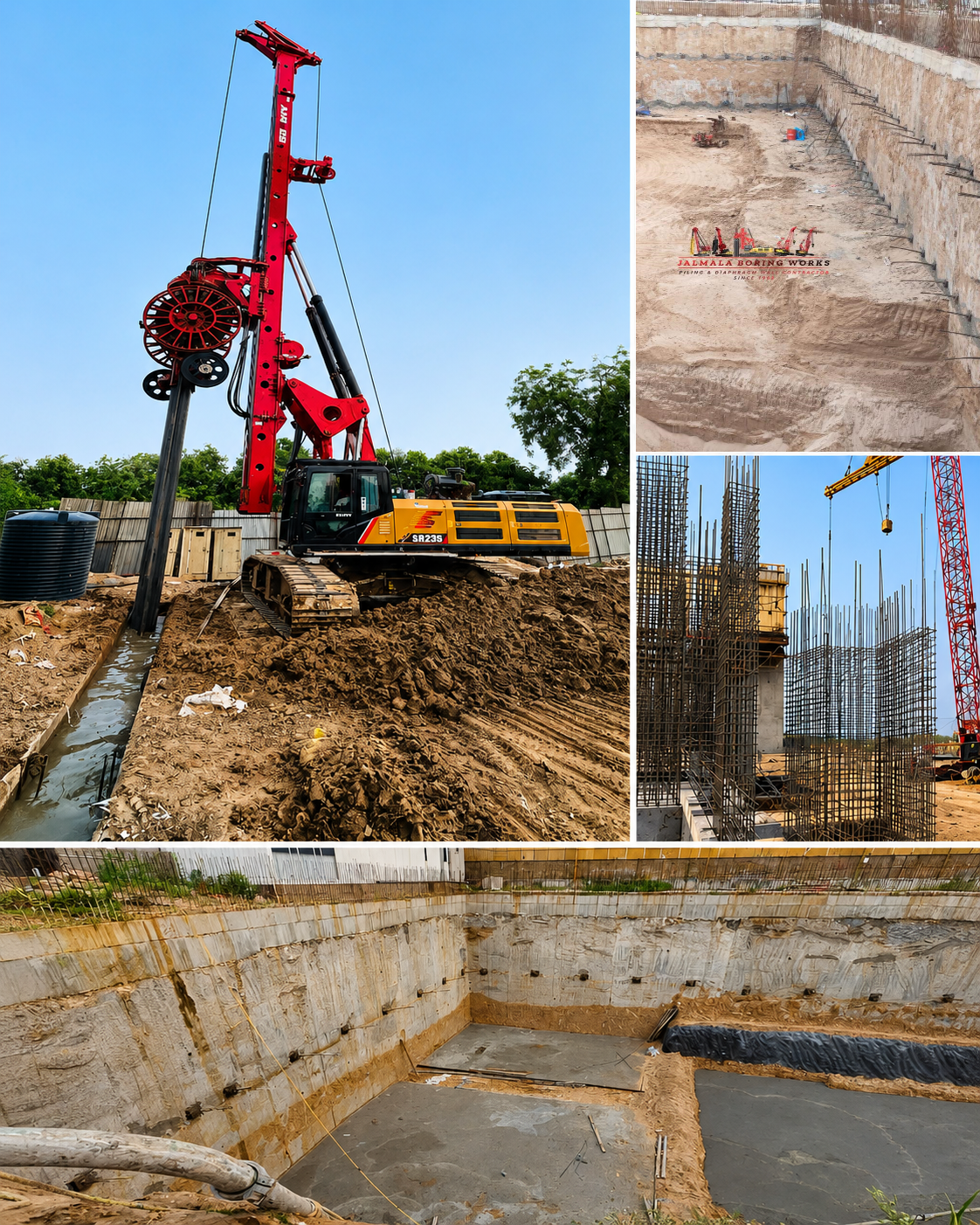
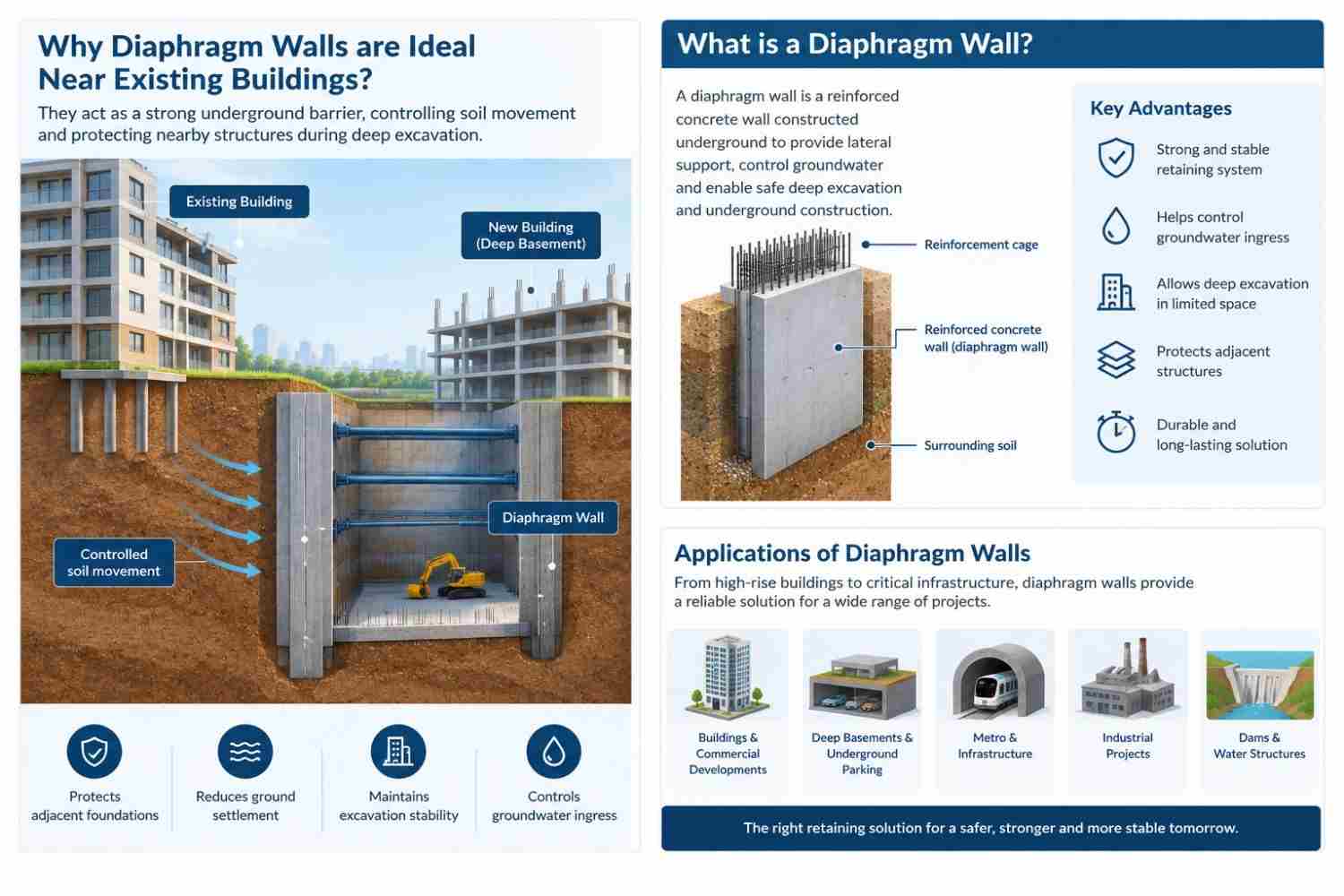
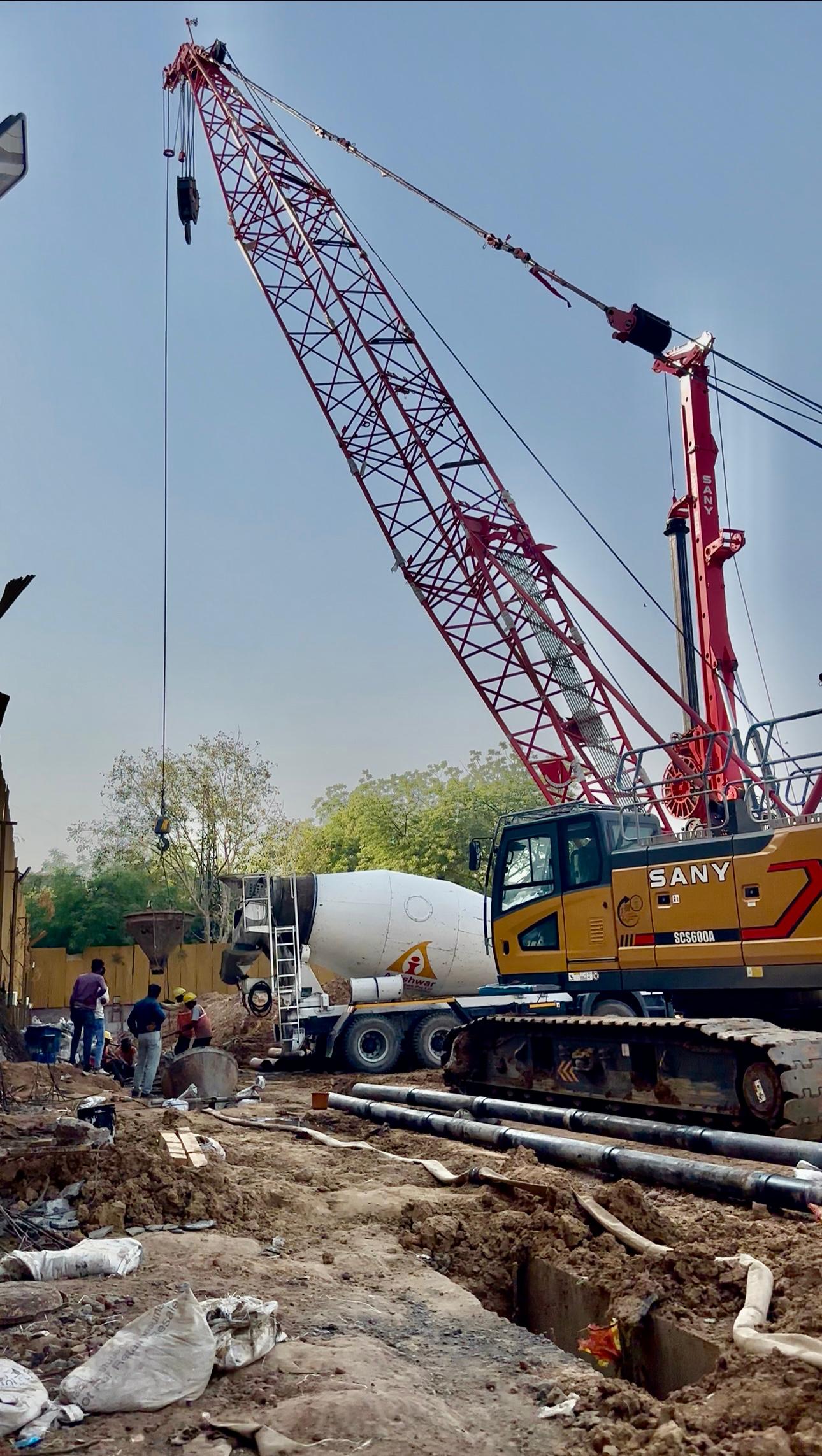
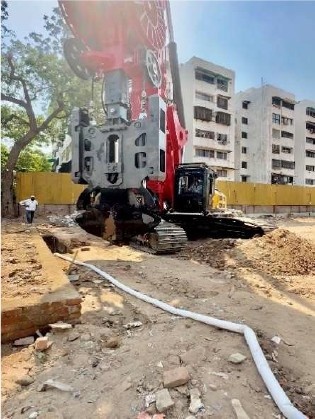
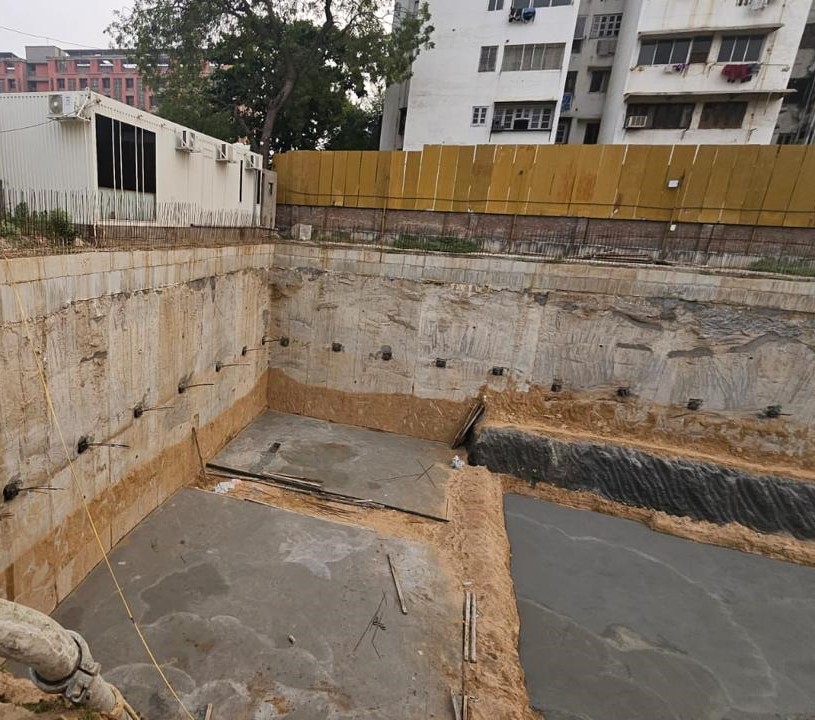
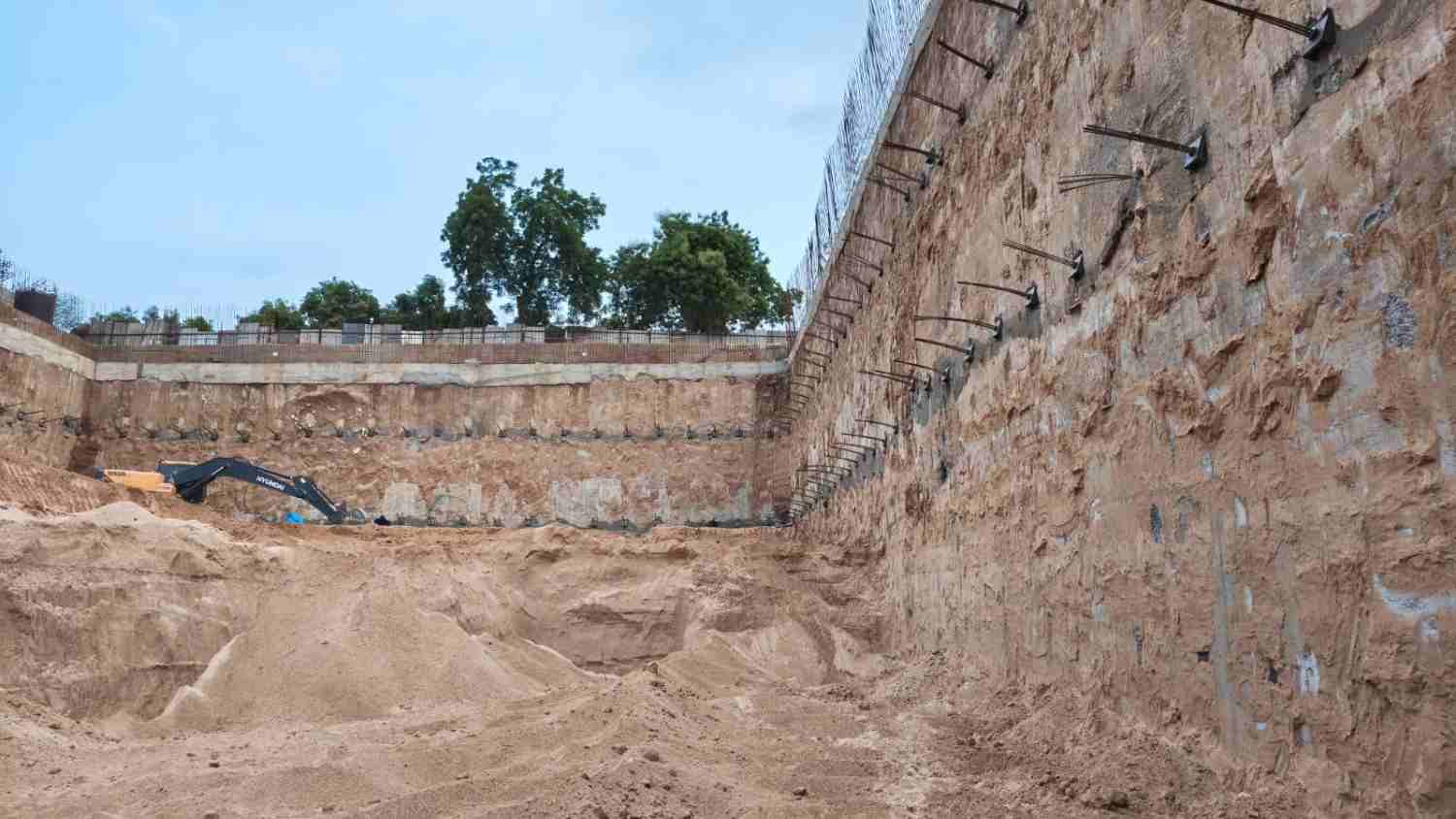
Jalmala Boring Works specializes in Diaphragm Wall Construction for deep excavations, basements, metro projects, commercial developments, and industrial infrastructure. We execute complete diaphragm wall work from 400 mm to 1200 mm thickness and depths of up to 40 metres, delivering watertight, high-strength retaining walls with minimal ground movement. Our end-to-end solution includes guide wall construction, slurry-supported panel excavation, reinforcement cage installation, tremie concreting, water-stop systems, and quality-controlled execution.

Diaphragm Walls: 400 mm – 1200 mm Thickness
Excavation Depths: Up to 40 Metres
Guide Wall Construction & Panel Excavation
Bentonite / Polymer Slurry Stabilization
Reinforcement Cage Installation
Tremie Concreting & Water-Stop Systems
Low Vibration & Watertight Retaining Walls
Ideal for Basements, Metro Stations, Underpasses & Industrial Projects
Jalmala Boring Works

Diaphragm WallConstruction Process

A step-by-step overview of how Jalmala Boring Works constructs high-quality Diaphragm Walls — from guide wall installation to final panel completion — with precision, safety, and six decades of expertise.

Step 01 – Survey, Setting Out & Guide Wall ConstructionStep 02 – Slurry Preparation & Panel ExcavationStep 03 – Joint Formation & Trench CleaningStep 04 – Reinforcement Cage InstallationStep 05 – Tremie ConcretingStep 06 – Panel Completion, Quality Control & Wall Formation
Active Step01 — Survey, Setting Out & Guide Wall Construction
01/06
Step 01 – Survey, Setting Out & Guide Wall Construction
Active Step01 — Survey, Setting Out & Guide Wall Construction
01

Survey, Setting Out & Guide Wall Construction

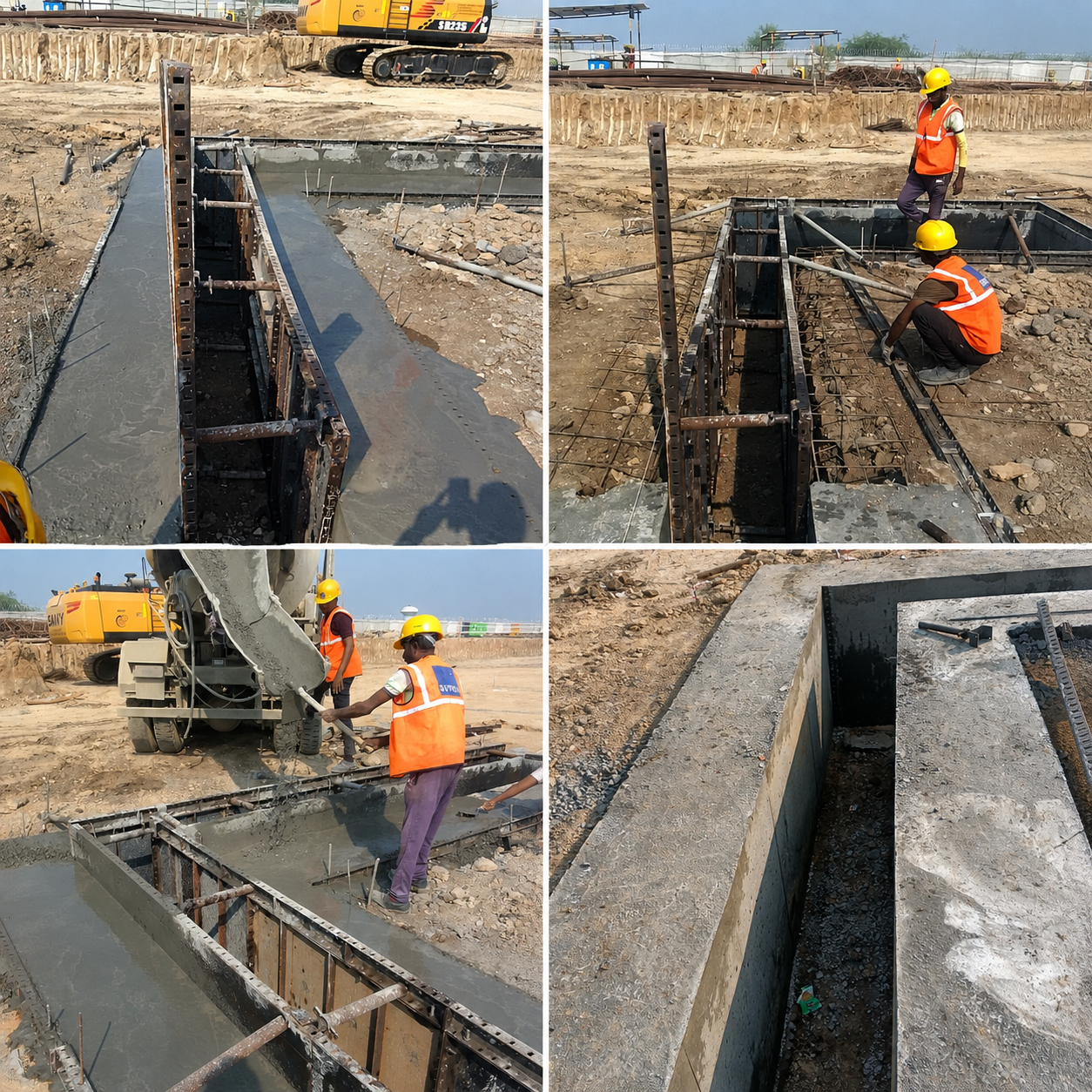
Detailed survey, panel marking, and guide wall construction for accurate alignment.

  • Detailed survey and panel layout marking
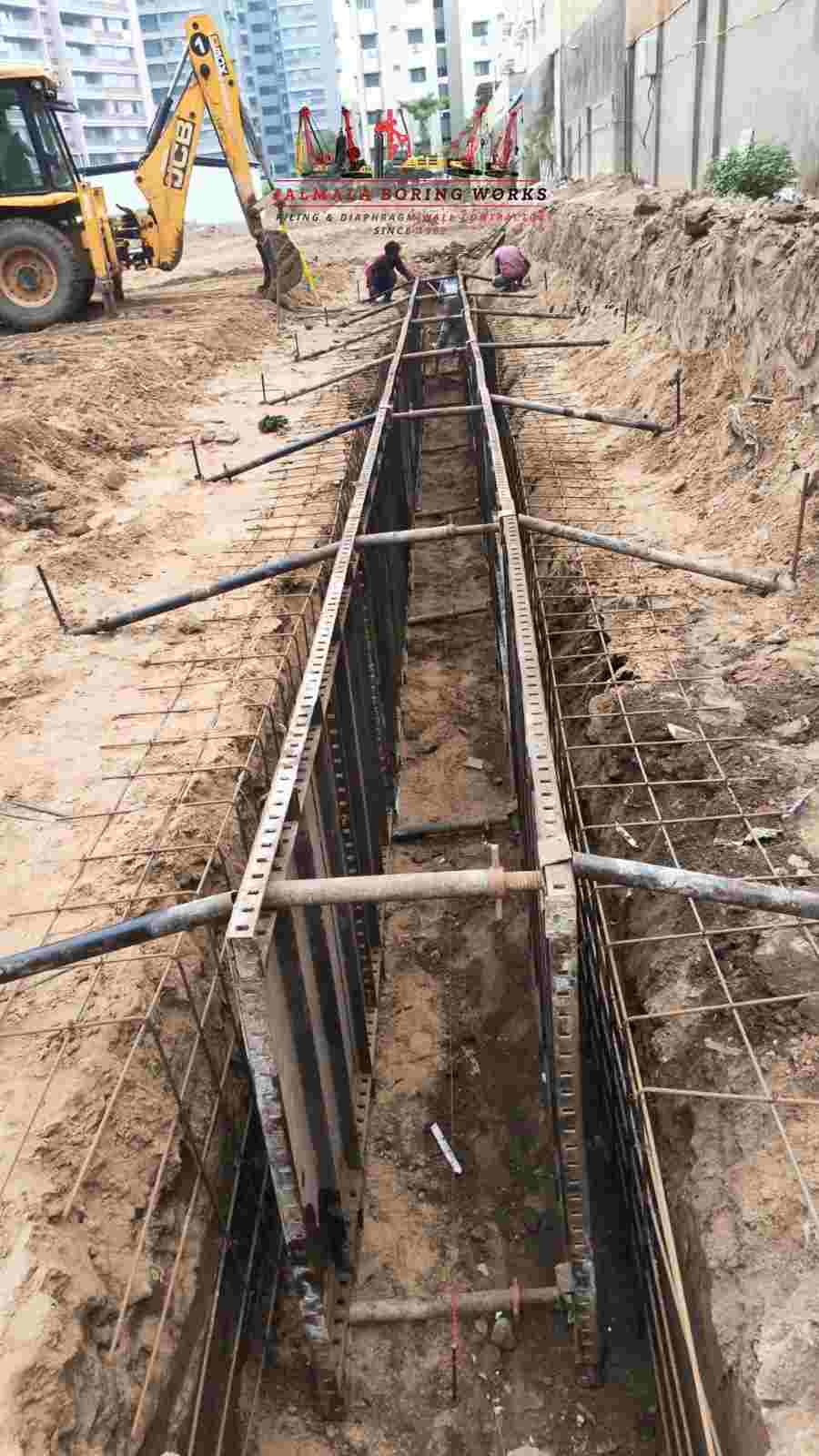
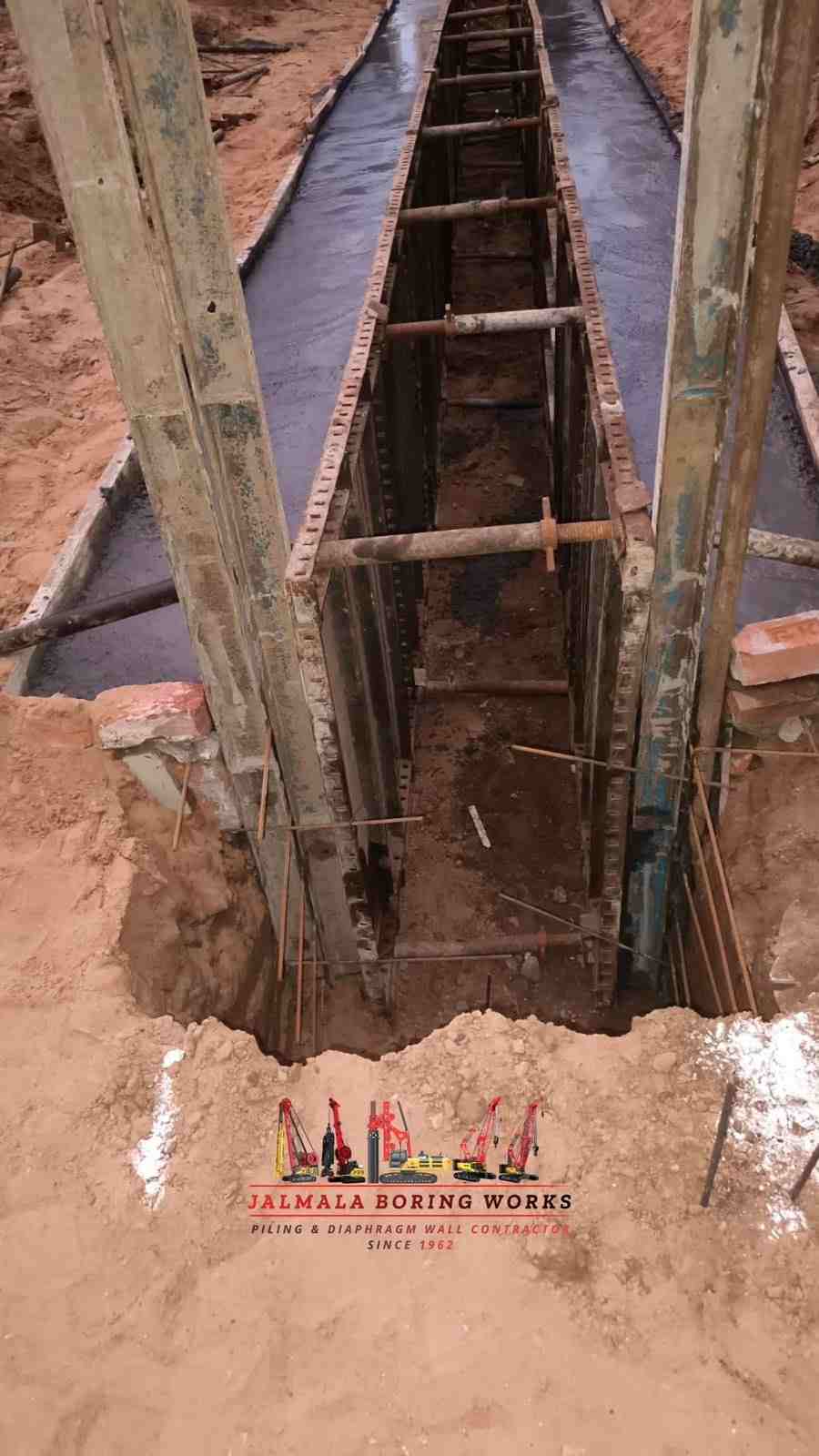
  • Construction of reinforced concrete guide walls
  • Establishes accurate wall alignment
  • Supports excavation equipment
  • Prevents top soil collapse during excavation
Phase 1
Step 02 – Slurry Preparation & Panel Excavation
Active Step02 — Slurry Preparation & Panel Excavation
02

Slurry Preparation & Panel Excavation

Preparation of slurry and excavation of diaphragm wall panels.

  • Preparation of bentonite/polymer slurry
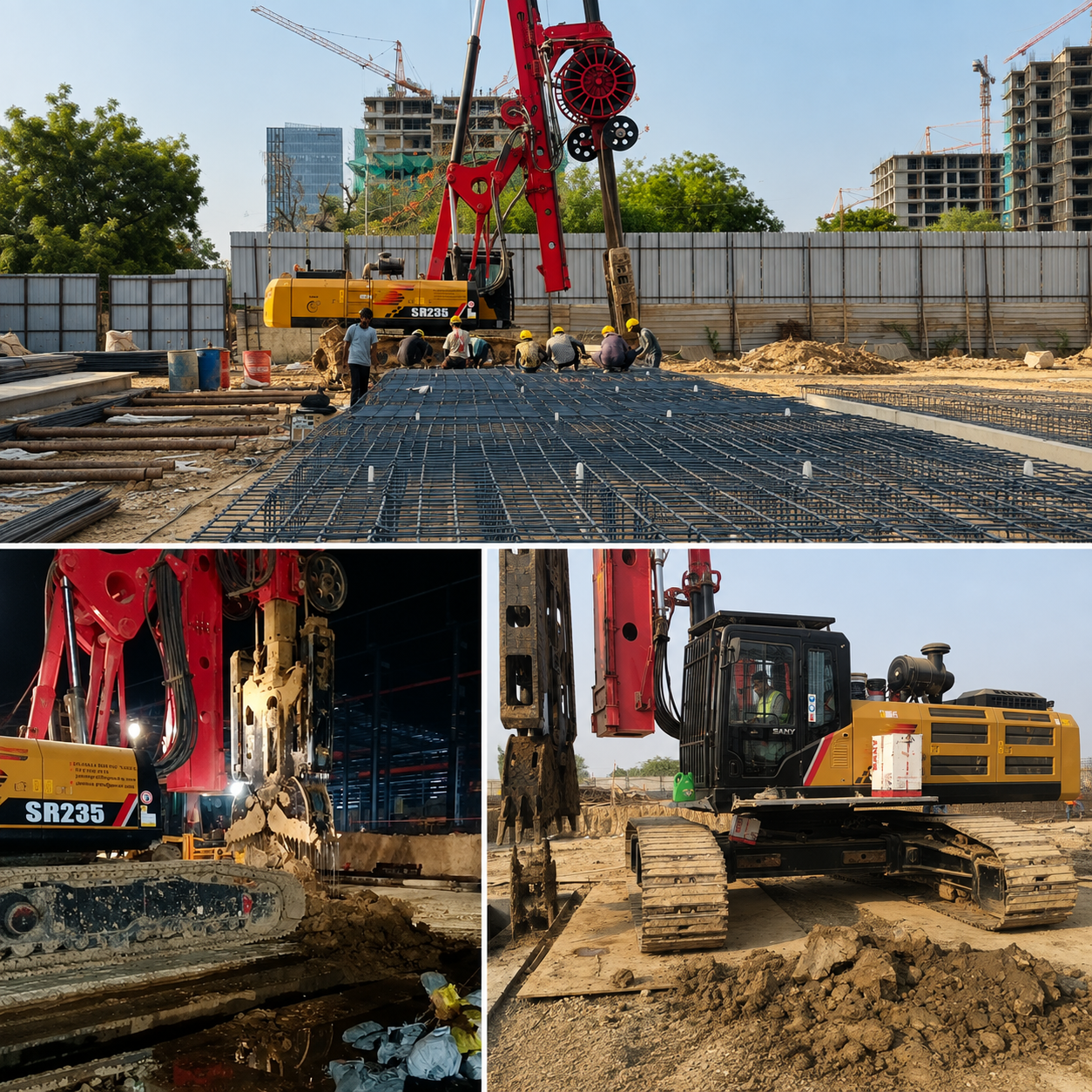
  • Excavation using Hydraulic Grab or Hydromill
  • Continuous slurry circulation for stability
  • Excavation to required depth and founding strata
  • Regular monitoring of depth and verticality
Phase 2
Step 03 – Joint Formation & Trench Cleaning
Active Step03 — Joint Formation & Trench Cleaning
03

Joint Formation & Trench Cleaning

Formation of watertight joints and cleaning of excavated trench.

  • Installation of Stop-End Pipes
  • PVC Water Stopper installation
  • Formation of watertight panel joints
  • Desanding and slurry cleaning
  • Removal of sediment from trench bottom
  • Final trench inspection
Phase 3
Step 04 – Reinforcement Cage Installation
Active Step04 — Reinforcement Cage Installation
04

Reinforcement Cage Installation

Fabrication and placement of reinforcement cage into trench.

  • Fabrication as per approved drawings
  • Installation of spacers and couplers
  • Lowering cage into slurry-filled trench
  • Maintains required concrete cover
  • Pre-concreting quality inspection
Phase 4
Step 05 – Tremie Concreting
Active Step05 — Tremie Concreting
05

Tremie Concreting

Continuous concrete placement using tremie pipes.

  • Installation of tremie pipes
  • Concrete poured from bottom to top
  • Displacement and recovery of slurry
  • Single uninterrupted concreting operation
  • Formation of reinforced concrete wall panels
Phase 5
Step 06 – Panel Completion, Quality Control & Wall Formation
Active Step06 — Panel Completion, Quality Control & Wall Formation
06

Panel Completion, Quality Control & Wall Formation

Final wall formation, testing, and quality assurance activities.

  • Removal of stop-end elements
  • Construction of secondary panels
  • Formation of continuous watertight wall
  • Verification of alignment and thickness
  • Concrete quality testing and records
  • Wall head trimming for capping beam
Phase 6
Precise Verticality
Watertight Wall
Urban-Friendly
Minimal Vibration
Featured Work

Recent Projects

2025–26
CALICA ECO SPACES PVT LTD
3 Eye Residence
Satellite, Ahmedabad, Gujarat
2025–26
CALICA ECO SPACES PVT LTD
3rd Eye Residence
Sabarmati, Ahmedabad, Gujarat
2025–26
SUROJ BUILDCON PVT LTD
Aggarwal Metals Works
Vithalpur, Gujarat

Ahmedabad D-Wall Construction — 8-Stage Methodology

Step-by-step construction process with IS 2911 quality checks at each stage — adapted to Ahmedabad's soil conditions.

01

Guide Wall Construction

RC guide walls cast on both sides of the trench line — maintaining alignment, supporting topsoil, and providing the reference for verticality checks across Ahmedabad's varied ground conditions.

✓ QC Check: Line, level, and verticality verified before excavation begins.

02

Bentonite Slurry Preparation

Bentonite mixed to design density and viscosity, hydrated in tanks, and continuously desanded — critical in Ahmedabad where Sabarmati alluvium and black cotton patches require carefully controlled slurry rheology.

✓ QC Check: Density, viscosity, pH, and sand content tested daily.

03

Trench Excavation

Hydraulic grab or cutter excavates each panel to design depth and width — with real-time verticality monitoring, particularly important on Ahmedabad's dense SG Highway and Prahladnagar sites.

✓ QC Check: Depth, width, and verticality measured by Koden or ultrasonic logging.

04

Trench Cleaning

Slurry is circulated and desanded to remove suspended soil particles. The trench base is cleaned of any sediment before reinforcement lowering — critical where Ahmedabad's sandy western soils (Shela, South Bopal) tend to contaminate slurry faster.

✓ QC Check: Slurry density and sand content re-verified — must meet IS 2911 limits.

05

Reinforcement Cage Lowering

Rebar cages fabricated to IS 456 with cover blocks and stopper plates are lifted and lowered gently into the slurry-filled trench without deformation.

✓ QC Check: Cage alignment, cover, and stopper plate position verified.

06

Tremie Concreting

Concrete placed by tremie pipe under slurry from the base upward — displacing slurry uniformly. Slump and density controlled to prevent segregation, essential in Ahmedabad's humid monsoon conditions.

✓ QC Check: Slump, cube sampling, and tremie embedment verified.

07

Stop-End Pipe Extraction

Stop-end pipe (forming the panel joint) extracted at the correct concrete setting time — the single stage most critical to joint water-tightness for Ahmedabad's high-water-table sites.

✓ QC Check: Extraction time, force, and joint integrity verified.

08

Panel Integrity Testing

Cross-hole sonic logging (CSL) using embedded access tubes verifies concrete continuity and joint quality in every production panel — in-house under the same ISO 9001:2015 framework as construction.

✓ QC Check: CSL logs analysed — any anomaly investigated and reported.

Ahmedabad Soil Conditions We Handle

  • →Sabarmati alluvium — layered soils along the river corridor
  • →Black cotton patches — swell potential in parts of central Ahmedabad
  • →Sandy coastal-type soils — western growth corridors (Shela, South Bopal)
  • →High water table — need for trench stability & water-tight joints
  • →Mixed fill material — urban redevelopment sites on SG Highway
  • →Proximity to existing structures — SG Highway, Prahladnagar, Bodakdev

Ahmedabad D-Wall Construction Applications

  • →Deep Basement Retention Walls (SG Highway, Prahladnagar)
  • →Ahmedabad Metro Cut-and-Cover Station Walls
  • →Commercial Basement Walls (Gift City, Bodakdev)
  • →Residential High-Rise Basements (Satellite, Bopal, Shela)
  • →Underpass & Tunnel Approach Walls (Ahmedabad ring roads)
  • →Cut-Off Walls for Sumps & Pump Houses
  • →Industrial Containment Sumps (Sanand, Changodar)
  • →Water Treatment Plant Walls

Serving All Ahmedabad from Sarkhej

Sarkhej

Base location

Bopal

~10 km · 30–60 min

South Bopal

~12 km · 30–60 min

Satellite

~10 km · 30–45 min

Vastrapur

~11 km · 30–45 min

Prahladnagar

~12 km · 30–60 min

SG Highway

~14 km · 30–60 min

Sindhu Bhavan Road

~15 km · 30–60 min

Bodakdev

~13 km · 30–55 min

Shela

~12 km · 30–50 min

Maninagar

~18 km · 45–75 min

Chandkheda

~20 km · 45–75 min

Gota

~18 km · 45–70 min

Motera

~22 km · 45–75 min

Naranpura

~16 km · 40–65 min

Gandhinagar

~32 km · 45–75 min

Diaphragm Wall Construction in Ahmedabad – Constructing Since 1962

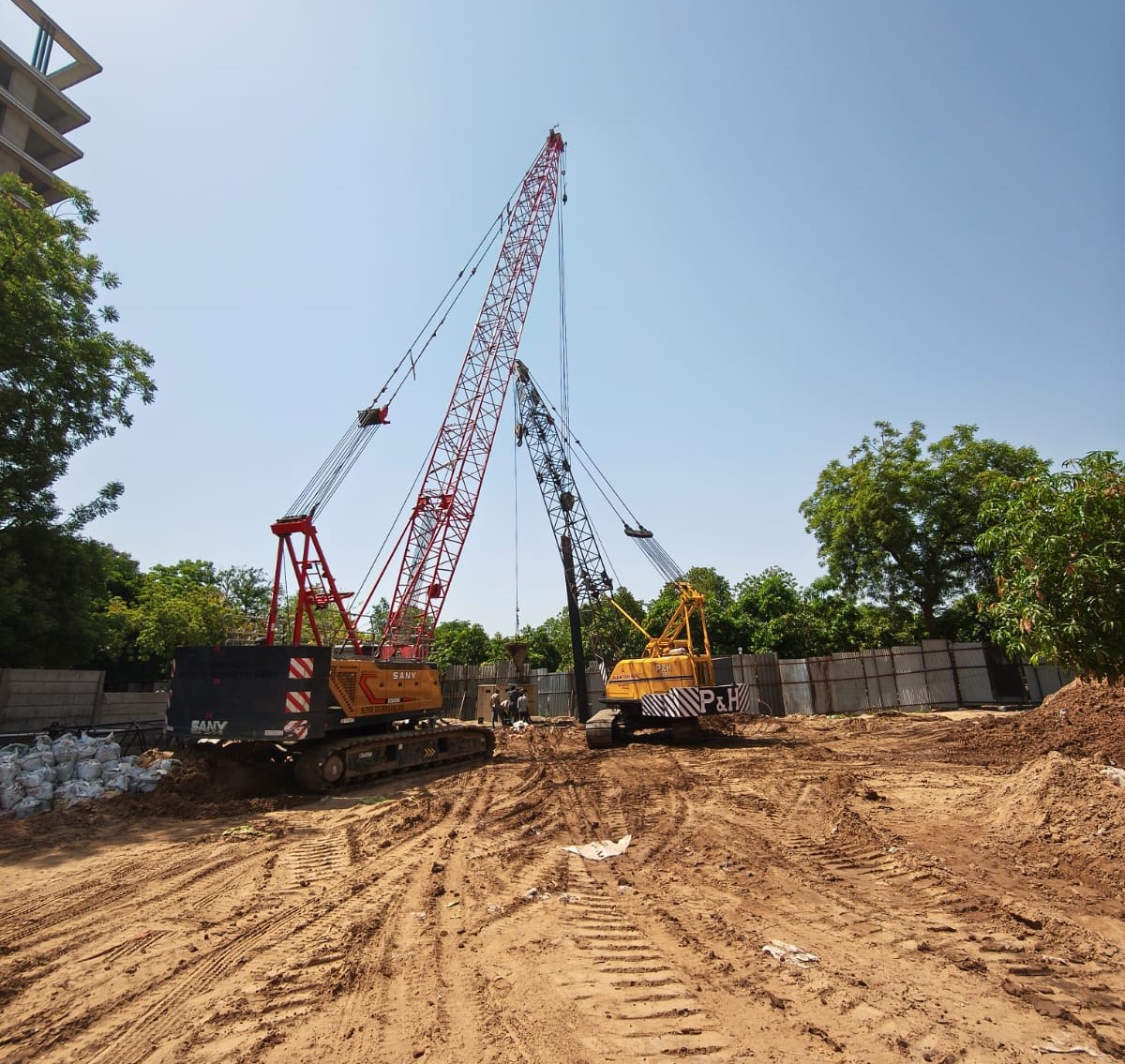
Diaphragm wall construction in Ahmedabad is not the same as D-wall construction anywhere else. Ahmedabad's urban sites are dense — SG Highway, Prahladnagar, Bodakdev, and Satellite all have close neighbouring structures, tight access, and live traffic corridors. Its soils are varied — Sabarmati alluvium along the river, black cotton patches in parts of central Ahmedabad, and sandy western growth corridors like Shela and South Bopal that contaminate slurry faster. And its water table and monsoon cycles demand carefully controlled construction sequencing at every stage. Getting D-wall construction right in Ahmedabad requires a contractor with deep local process expertise, not just one who owns a hydraulic grab. Jalmala Boring Works has been constructing diaphragm wall construction in Ahmedabad since 1962 — over six decades of panel-by-panel execution for deep basements, Ahmedabad Metro cut-and-cover stations, cut-off walls, and water barriers across the city. As a third-generation, family-owned business based in Sarkhej, our diaphragm wall construction in Ahmedabad team combines construction process expertise with an in-house fleet of SANY hydraulic grab and cutter rigs.

We construct diaphragm walls for deep basements, Ahmedabad Metro cut-and-cover stations, tunnel and underpass approaches, cut-off walls for sumps and pump houses, industrial containment sumps (Sanand, Changodar), and water treatment plant walls across every Ahmedabad locality — Bopal, South Bopal, Satellite, Vastrapur, Prahladnagar, SG Highway, Sindhu Bhavan Road, Bodakdev, Shela, Maninagar, Sarkhej, Chandkheda, Gota, Motera, Naranpura, and east Ahmedabad. Whether your project requires a 6-metre retention wall for a single-basement building in Satellite or a 40-metre deep D-wall package for the Ahmedabad Metro, our diaphragm wall construction in Ahmedabad team applies the same construction process discipline on every panel — a promise that has earned us a 4.9★ average rating from 5 verified Ahmedabad clients and kept developers, structural consultants, and metro EPCs returning to Jalmala Boring Works for three generations.

Step-by-Step Diaphragm Wall Construction Process in Ahmedabad

Every panel of diaphragm wall construction in Ahmedabad follows eight essential stages. First, guide wall construction: RC guide walls are cast on both sides of the proposed trench — they maintain alignment, support the topsoil, and provide the reference for verticality checks across Ahmedabad's varied ground conditions. Second, bentonite slurry preparation: bentonite is mixed to design density and viscosity, hydrated, and continuously desanded — critical in Ahmedabad where Sabarmati alluvium and black cotton patches require carefully controlled slurry rheology. Third, trench excavation: hydraulic grab or cutter excavates each panel to design depth and width — with real-time verticality monitoring, important on Ahmedabad's dense SG Highway and Prahladnagar sites. Fourth, trench cleaning: slurry is circulated and desanded to remove suspended soil particles before cage lowering — critical where Ahmedabad's sandy western soils (Shela, South Bopal) contaminate slurry faster. Fifth, reinforcement cage lowering: cages fabricated to IS 456 are lowered gently into the slurry-filled trench without deformation. Sixth, tremie concreting: concrete placed from the base upward via tremie pipe — displacing slurry uniformly, with slump and density controlled to prevent segregation. Seventh, stop-end pipe extraction: the pipe forming the joint is extracted at the right concrete setting time — the single stage most critical to joint water-tightness for Ahmedabad's high-water-table sites. Eighth, CSL integrity testing: cross-hole sonic logging verifies concrete continuity and joint quality. Our diaphragm wall construction in Ahmedabad team executes every stage in-house under ISO 9001:2015 with documented QC at each step.

How Ahmedabad Soil Conditions Affect D-Wall Construction

Ahmedabad's soil variability is one of the reasons diaphragm wall construction in Ahmedabad requires local expertise. Along the Sabarmati corridor, layered alluvial soils require careful slurry density control to prevent trench collapse at abrupt stratum transitions. In central Ahmedabad, black cotton patches with high swell potential require additional joint detailing and often a lower excavation rate. In the western growth corridors — Shela, South Bopal, and the new areas beyond SG Highway — sandy soils tend to migrate into the slurry quickly, demanding faster desanding cycles and tighter sand content limits. Urban redevelopment sites on SG Highway often contain mixed fill material, which requires adjustment to trench stability monitoring. And everywhere in Ahmedabad, the monsoon and post-monsoon water table fluctuations demand tighter joint water-tightness standards — which is why stop-end pipe extraction timing is monitored so carefully in every panel we cast in Ahmedabad.

Panel Sequencing and Quality Verification in Ahmedabad

The sequencing of panels is what distinguishes D-wall construction from other deep foundation systems. Panels are constructed in an alternating primary–secondary pattern: primary panels are excavated, reinforced, and concreted first; then secondary panels are excavated between them, with stop-end pipes forming the joint. On Ahmedabad's dense urban sites — particularly SG Highway, Prahladnagar, and Bodakdev where adjacent structures are close — sequencing also needs to account for vibration limits and continuous slurry circulation between phases. Quality verification is stage-by-stage, not end-of-project: guide wall line and level are verified before excavation, bentonite density and viscosity are tested daily, trench verticality is measured by Koden or ultrasonic logging, slurry sand content is re-verified before cage lowering, cage alignment and cover blocks are checked, concrete slump and cube samples are taken, stop-end pipe extraction timing is logged, and CSL testing verifies every production panel. All these records are compiled into a panel log — the single document your Ahmedabad structural consultant and PMC can use to accept the wall. Our diaphragm wall construction in Ahmedabad team delivers complete QC documentation with the completed wall.

Serving Ahmedabad and Pan-India

Headquartered in Ahmedabad at Dholka Road, near Nariampura Village, Sarkhej-Okaf, our diaphragm wall construction in Ahmedabad operations cover every major Ahmedabad construction corridor — deep basements across SG Highway, Prahladnagar, and Gift City; metro cut-and-cover in Ahmedabad; underpasses and tunnels; and industrial D-wall packages in Sanand and Changodar — and extend to 20+ Indian states. From high-rise basement retention in Ahmedabad to metro station walls and cut-off barriers, we bring the same construction process discipline to every site. When you need diaphragm wall construction in Ahmedabad with genuine process and pan-India capability, Jalmala Boring Works is ready to mobilise.

Frequently Asked Questions

What is the diaphragm wall construction process in Ahmedabad?

Eight core stages: guide wall construction, slurry preparation, trench excavation, trench cleaning, cage lowering, tremie concreting, stop-end pipe extraction, and CSL testing — each with IS 2911 quality checks adapted to Ahmedabad's soil conditions.

How is D-wall construction adapted to Ahmedabad soil conditions?

Ahmedabad's Sabarmati alluvium, black cotton patches, and sandy western growth corridors (Shela, South Bopal) each demand different slurry rheology, desanding rates, and joint detailing. Our 60+ years of local experience guides these adaptations.

How fast can you mobilise D-wall construction in Ahmedabad?

24–48 hours for Bopal, Satellite, Prahladnagar, SG Highway, and Bodakdev. 48–72 hours for Maninagar, Chandkheda, Gota, Motera, and Naranpura — from our Sarkhej base.

What is the client rating of Jalmala Boring Works in Ahmedabad?

Jalmala Boring Works holds an average client rating of 4.9★ out of 5, based on 5 verified diaphragm wall construction project reviews from Ahmedabad.

Contact Our D-Wall Construction Team in Ahmedabad Today

Discuss your D-wall construction scope with Mr. Amrulla Memon at +91 93745 45415 or email jalmala.pile@gmail.com. Our office is at Dholka Road, near Nariampura Village, Narimanpura, Sarkhej-Okaf, Ahmedabad, Gujarat 382210 — near you, and ready to mobilise. When you need trusted diaphragm wall construction in Ahmedabad with 60+ years of process discipline, ISO 9001:2015 certification, a 4.9★ client rating, and in-house SANY grabs plus CSL testing, choose Jalmala Boring Works.

What Our Ahmedabad D-Wall Construction Clients Say

4.9 / 5based on 5 verified reviews
B

Bhavesh Trivedi

1 Dec 2025

Best D-wall construction process in Ahmedabad

Jalmala's diaphragm wall construction for our 4-level basement near SG Highway was executed with impressive process discipline. Guide walls, bentonite desanding, cage lowering, tremie placement, and stop-end extraction — every stage followed the QC protocol precisely. All 46 panels passed CSL testing with zero defects.

D

Deepak Shah

31 Oct 2025

Reliable D-wall construction in Ahmedabad with excellent QC

We engaged Jalmala for D-wall construction at our commercial project in Prahladnagar. Their panel sequencing and stop-end extraction timing were executed to precision — zero joint leaks during excavation. Their daily bentonite test records and panel logs made the whole PMC sign-off simple.

R

Rajan Mehta

16 Sept 2025

Best D-wall construction methodology we've seen in Ahmedabad

After evaluating 5 contractors, we chose Jalmala for their construction methodology and in-house CSL capability. They executed 62 panels for our metro cut-and-cover section — construction sequencing, joint detailing, and tremie concreting all to IS 2911 standards. Ahmedabad's best D-wall construction team.

H

Hitesh Patel

10 Jul 2025

Strong D-wall construction process with excellent safety

D-wall construction on our Satellite site had high water table and close neighbours. Jalmala's construction process — slurry density control, panel sequencing, and continuous monitoring — was professionally managed. Minor weather delay but construction quality and safety were excellent.

N

Nirav Desai

24 May 2025

Trusted D-wall construction partner for our Bopal project

Jalmala executed D-wall construction as a cut-off barrier for our Bopal industrial sump. Their precision in joint formation and water-tightness was impressive. The stage-by-stage construction documentation made our consultant sign-off stress-free. Fully water-tight wall delivered ahead of schedule.

Reviews shown are from verified Ahmedabad diaphragm wall construction client projects. To leave a review, contact us at jalmala.pile@gmail.com.

Ready to Start Your Ahmedabad D-Wall Construction?

Speak directly to our team — no middlemen, no delays.